
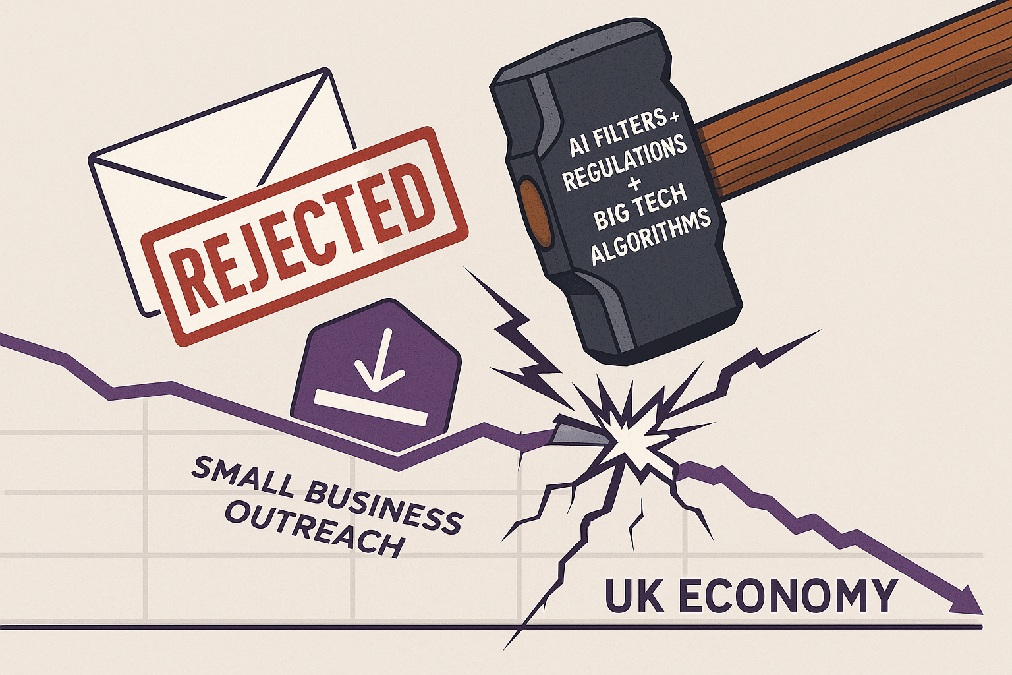
The UK economy is being quietly damaged by a collapse in small business marketing, as every affordable route to reach new customers is shut down by AI filters, regulations, and Big Tech algorithms. The result is a silent visibility crisis for 99% of UK SMEs — and an economic slowdown that ministers still can’t explain.
The UK didn’t stumble into stagnation, Big Tech and over-regulation choked the small business sector until it couldn’t breathe. And no one in power is even acknowledging it.
For 20 years, small businesses had one reliable growth engine:
the ability to get in front of people.
Cold email. Cheap ads. Local SEO. Facebook reach. LinkedIn visibility.
It wasn’t glamorous, but it worked. It kept recruiters fed, consultants afloat, and service companies alive.
Today?
That engine has been dismantled. Quietly. Systematically. And with devastating consequences.
Governments are wondering why the economy is stagnant.
Small businesses are wondering why enquiries dried up.
Meanwhile, Big Tech and big corporations are doing just fine.
This isn’t a mystery.
It’s cause and effect.
And the evidence is brutal.
1. Cold Email — the Channel That Built Small Business — Is Essentially Dead
Cold email used to be the simplest, cheapest way for a small business to introduce itself.
Not anymore.
In 2024–2025, cold email deliverability collapsed because inbox providers rewrote the rules.
Unless you send:
- tiny volumes
- to perfectly verified micro-lists
- from multiple domains
- with human-style timing
…your emails will go straight to junk.
For large lists (600+, 1,000+, 3,000+):
👉 Deliverability tanks
👉 Domain reputation drops
👉 Warm lists outperform cold by 10–20×
👉 Future emails — even legitimate ones — get punished
Why?
Because between 2019 and 2023, cold outreach exploded:
Cold email volume tripled.
Spam filters couldn’t keep up.
So Gmail, Microsoft and Yahoo did the one thing they could:
They slammed the door shut.
2. AI Filters Now Judge Your Email Before It Even Reaches an Inbox
Inbox providers use:
- AI content analysis
- behavioural scoring
- domain reputation modelling
- engagement prediction
This AI can detect:
- “This looks like cold outreach.”
- “This sender has low engagement.”
- “This resembles mass marketing.”
Even if your message is polite, relevant and legitimate — the pattern kills it.
We have entered a world where an AI decides if your business deserves visibility.
3. New Laws (2023–2024) Pushed Providers Into Extreme Risk Avoidance
- US states rolled out GDPR-style privacy laws
- EU fines on Google, Meta, Microsoft hit billions
- UK GDPR remains strict
Big Tech became terrified of liability.
So they tightened filtering to the point where small-business outreach became collateral damage.
By doing this they are driving businesses to the wall – and little do they care as long as the profits keep rolling in.
4. Cold Email Is Now Categorised as a Cybersecurity Threat
Inbox providers now treat bulk cold outreach like:
- phishing
- malware distribution
- fraud attempts
- impersonation
- mass bots
Legitimate SME outreach is being thrown into the same bucket as cybercrime.
This is not an exaggeration — it’s exactly what the algorithms are doing.
5. User Experience Became More Important Than Small Business Survival
Platforms realised:
- Users hate cold outreach
- Users mark it as spam instantly
- Low-engagement senders harm platform reliability
So the algorithms now reward:
✔ warm contacts
✔ replies, not opens
✔ personal relationships
✔ slow, natural sending patterns
Meaning:
❌ Bulk campaigns are punished
❌ Volume triggers spam filters automatically
6. Google & Yahoo’s 2024 Sender Requirements Crashed the Industry
For anyone sending bulk email, the new rules require:
- SPF, DKIM, DMARC
- One-click unsubscribe
- Proof of consent
- Frequency limits
- Complaint rate below 0.3%
If 3 people out of 1,000 click “spam”, your domain reputation collapses.
Most cold email providers and data suppliers cannot meet these thresholds anymore.
7. Your Domain Reputation Is Now Your Business’s Credit Score
Your domain is scored on:
- engagement
- bounce rates
- complaints
- sending volume
- cold vs warm patterns
If your score drops:
👉 All emails — even invoices and client messages — go to spam
👉 Recovery takes months
👉 Your outreach becomes toxic
This is why using your main domain for cold email is now dangerous.
8. Big Tech Is Pushing SMEs Into Paid Advertising
Much to the detriment of small businesses as it can be price prohibitive to advertise.
Google, Meta, Microsoft and LinkedIn earn more when:
- businesses use ads
- businesses abandon cold email
- businesses pay for CRM-approved messaging
- businesses buy visibility instead of earning it
Cold email competes with their revenue streams.
So the platforms suffocate it.
Not by banning it — but by making it impossible to succeed.
Big Tech has a monopoly stranglehold on the advertising industry and that needs to be broken if SMEs are to survive.
The Result: The Old B2B Marketing Model has collapsed
For a decade, small businesses relied on:
- cold email
- Google Ads
- cheap digital visibility
All of this is now throttled, regulated, restricted, or priced beyond reach.
Small business didn’t change.
The world around it did — aggressively and without warning.
The economic consequences are real – and Government refuses to connect the dots
Small businesses are not “nice-to-haves.”
They ARE the UK economy:
- 99% of the business population
- 48% of private sector turnover
- 61% of employment
When small businesses cannot reach new clients:
- hiring slows
- innovation drops
- wage growth stalls
- high streets decline
- tax revenue shrinks
- productivity stagnates
Politicians talk endlessly about “growth”, yet they ignore the elephant in the room:
Small business growth has been technologically throttled at the source.
You cannot grow an economy when the people who create the growth can no longer reach the people who need them.
Big companies are not suffering – SMEs are
Large corporations can afford:
- multi-million-pound ad budgets
- deliverability teams
- compliance teams
- premium sender authentication
- lobbying influence
- brand recognition
- armies of content creators
They can navigate the new rules.
Small businesses cannot.
This is how an economy becomes imbalanced — and eventually stagnates.
The low-cost visibility channels that fuelled small business growth from 2010 to 2020 have vanished – all at once.
Cold email → gone
Organic Facebook → gone
Organic LinkedIn → throttled
Cheap Google Ads → priced out
SEO → crowded and pay-to-play
iOS tracking → removed
Email deliverability → crippled
Think about that.
Every route a small business once used to reach new customers has either been blocked, monetised, or destroyed.
And no one in government has connected this to the wider economic slowdown.
So what now?
The old model is dead:
❌ blast 1,000+ emails
❌ post on LinkedIn and hope
❌ cheap ads to fill the pipeline
The new model is slower, more specialist, more relationship-driven:
✔ micro-targeting 20–50 ideal prospects
✔ trust content instead of sales content
✔ warm relationships, not cold lists
✔ credibility, not volume
✔ niche expertise, not mass messaging
This transition is painful.
It’s slow.
It feels like everything is broken.
But it’s not small business that’s broken —
it’s the infrastructure SMEs rely on.
Until Government acknowledges this, the economy cannot fully recover
You cannot strangle the marketing channels of the nation’s largest employer (SMEs) and then stand at a podium asking why growth is weak.
If small businesses cannot introduce themselves,
they cannot grow.
If they cannot grow,
the economy cannot recover.
This is not theory.
This is not politics.
This is basic arithmetic.
And it’s time someone said it plainly.
If we don’t fix the systems that silence small businesses, we don’t just lose enquiries — we lose the very engine of the UK economy.
 Enough Already